
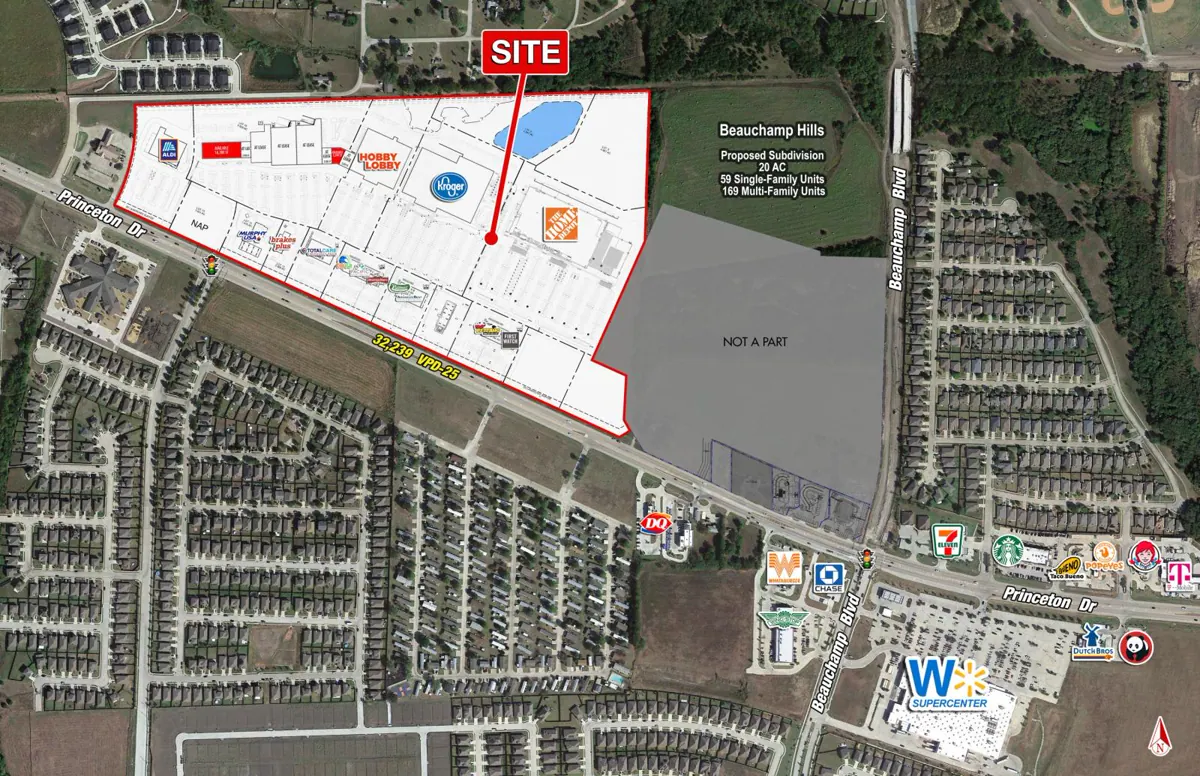
A 66+ acre retail and development site near U.S. 380 shows the scale of projects still moving forward as Princeton’s growth continues. (Image: Shop Companies)
What changed, why it changed, and what it means for traffic, schools, police, housing, and the future of Princeton
Quick Read
• Princeton paused new residential development in September 2024 because city leaders said roads, water, wastewater, and emergency services were struggling to keep up with growth.
• That pause was extended, but Texas later passed House Bill 2559, which made it much harder for cities to keep using moratoriums to slow development.
• Princeton’s moratorium officially ended on November 30, 2025.
• Since then, development has continued moving again. The Dallas Observer reported Princeton finished 2025 with 1,600 building permits, and City Council later approved another 48.776-acre final plat on March 9, 2026.
• The bigger story is not just that growth resumed. It is what that growth is already doing to daily life. Police calls jumped 34% to 28,346 in 2025; Princeton ISD added 1,404 students in one year; and U.S. 380 widening won’t finish until late 2028—meaning strain is arriving faster than relief.
Bottom line: Princeton did try to hit the brakes. The city no longer has the same ability to keep doing that, and the effects of renewed growth are already showing up in ways residents can feel right now.
This Is Not Just a Development Story
This is a story about whether Princeton can keep up with the version of itself that is already arriving.
Princeton became the fastest growing city in the country in the latest Census release. WFAA later reported the city is bracing for roughly 6,000 new residents and 2,000 new homes each year if current trends continue.
That is why this issue is so heated. People are not arguing about growth in the abstract. They are arguing about the roads they sit on, the schools their kids go to, the police and emergency response they depend on, and whether Princeton is becoming the kind of city they actually want to live in. Public discussion across Facebook and Reddit keeps circling back to the same things: traffic on 380, infrastructure lag, approved homes already in the pipeline, and whether the city expanded too fast.
What Princeton Did, and Why
On September 23, 2024, Princeton imposed a temporary moratorium on new residential development. KERA reported the city said the pause was needed because rapid growth was stressing infrastructure and city services. The Princeton Journal’s own October 11, 2025 reporting likewise said the moratorium was first adopted on September 23, 2024, and was meant to give staff time to reassess infrastructure capacity and development standards during a period of record growth. Already approved developments were allowed to continue.
In January 2025, City Council extended the moratorium. KERA reported City Manager Michael Mashburn described the pause as a way to create “sensible growth” while Princeton tried to catch up on basics expected of a city nearing 40,000 people. TPJ’s own reporting later framed the same reality more directly: the city had paused growth because roads, drainage, utilities, and public safety were under pressure, and November 30, 2025, would be the turning point when the city either resumed growth under tighter scrutiny or found some narrower way to slow it again.
That matters because it shows the city was not treating this as symbolic politics. It was openly acknowledging that growth had outrun parts of Princeton’s capacity.
What Changed at the State Level
Then the rules changed.
Spectrum reported that House Bill 2559, signed into law in 2025, sharply restricted how Texas cities can use development moratoriums. The law added hearing and timing requirements and, as Spectrum and Dallas Observer both reported, limited cities to essentially one moratorium every two years on the same issue in the same area. TPJ’s October 11, 2025, article explained the same thing in practical terms: after September 1, 2025, broad citywide pauses would be much harder to renew, which meant Princeton would likely have to rely more on stricter enforcement, project phasing, and detailed review than on blanket freezes.
Spectrum also quoted Mayor Eugene Escobar Jr. saying the new law would make it harder for Princeton to keep growth at a manageable pace, even though thousands of homes were still coming.
That is the turning point in the story. Princeton did not simply decide growth was no longer a problem. The state narrowed one of the city’s main tools for slowing it down.
Why People Say Growth Is “Speeding Back Up”
Because the pause is over, and the pipeline is moving again.
TPJ reported in October 2025 that Princeton’s moratorium would expire on November 30, 2025, and that, unless a narrower replacement was adopted within HB 2559’s limits, the city would resume accepting and approving new residential plats under existing regulations. Dallas Observer later reported Princeton finished 2025 with 1,600 building permits, down from the prior year but still enough to add more than 5,000 residents, according to Princeton EDC CEO Jim Wehmeier. The same report said a significant backlog of single-family permits had still not been processed.
That is the part many people miss. Even after more than a year of moratorium periods, Princeton still had major growth pressure sitting behind the scenes. So when people say growth is speeding back up, they do not just mean that one council vote ended the pause. They mean the city is back in motion while thousands of future residents are still effectively in the queue.
What This Means for Traffic
This is where residents feel growth every day.

The Princeton Journal has already tracked this from both the construction side and the long-term freeway side. In October 2025, TPJ reported that U.S. 380 expansion work would start moving through Princeton in segments, with traffic pushed through lane shifts and construction barrels for roughly two and a half years. In December 2025, TPJ reported that the larger reality is not just a wider highway but a major transition toward a controlled-access freeway north of Princeton.
That means residents are living through both sides of the problem at once: current congestion and long-term reconstruction. Growth is happening now. Relief is phased, disruptive, and slow.
This is why the traffic section of the growth debate always feels so personal. Residents do not need to study a demographic chart to understand it. They feel it in their commute, in school pickup lines, and in how long it takes to get across town.
What This Means for Police and Emergency Response
Growth changes public safety in ways residents can measure.
The Princeton Journal’s own January 2026 reporting framed Princeton Police’s 2025 activity presentation as a citywide snapshot of calls, crime, traffic, and growth. That article reported police calls, traffic pressure, and enforcement activity in the context of a city adding residents rapidly. Then, in December 2025, TPJ reported City Council had approved key steps advancing Princeton’s planned Public Safety Complex for police and fire, including site control, architect selection, and major professional-services authorization.
That means the public-safety side of this story is not theoretical. Princeton is not only seeing more demand. It is already taking structural steps to expand police and fire capacity because the current footprint is not built for what the city is becoming.
More rooftops mean more calls, more wrecks, more patrol pressure, and more need for emergency capacity. That is one of the clearest ways growth leaves the realm of planning documents and enters everyday life.
What This Means for Schools
This is where the future becomes impossible to ignore.
The Princeton Journal’s own March 26, 2026 reporting showed Princeton ISD is planning for 19,574 students by 2034, says eight new campuses are planned, and reported 10,545 students on the first day of the 2025 school year, up 1,404 from the first day of 2024.
That matters because it means the school system itself is planning for a Princeton far larger than the one residents know today. The district is not reacting to a small bump. It is planning around sustained family growth large enough to require whole new campuses rather than just a few extra classrooms.
For families, this is what makes the growth debate real: school capacity, attendance boundaries, traffic around campuses, staffing, and how quickly new schools have to open just to prevent the system from falling behind.
What This Means for Housing, Retail, and What Comes Next
Growth is not only a burden story. It is also why Princeton keeps getting new rooftops, new financing districts, and the retail projects residents have wanted for years.
The Princeton Journal has already tracked several parts of that pipeline. In October 2025, TPJ reported that Princeton Town Center was planned at the northwest corner of U.S. 380 and Beauchamp, with 35 or more national brands and more than $3 million in projected annual sales tax at buildout. In February 2026, TPJ also reported that major drainage items for Town Center were still unresolved in the latest engineering review letter it located, showing that even highly visible growth projects can remain tied up in infrastructure and drainage review long after the public hears they are coming. And in another October 2025 report, TPJ found that upcoming PID actions tied to Windmore, Southridge, and Eastridge could support more than 2,000 new homes across those developments.
That is the tradeoff at the center of this whole fight.
A bigger Princeton can mean more stores, more jobs, more rooftops, and more tax base. But it also means more pressure on roads, schools, drainage, police, and emergency response, often before the city feels the full service benefit of that growth. As TPJ explained in its August 2025 analysis of Princeton’s growth-finance model, many new-growth dollars are committed to PIDs and TIRZ structures before the unrestricted general fund can fully catch up on police, fire, streets, and parks.
Both sides of the argument are reacting to something real. The people who want growth are reacting to the stores, jobs, rooftops, and amenities it can bring. The people who want it slowed are reacting to the lag between visible growth and visible relief.
What People Have Been Saying Before, During, and After
Before the moratorium, the public argument centered on whether Princeton was building faster than it could support. During the moratorium, the fight shifted to whether the city was finally doing what it should have done earlier or whether the pause came too late and left too many exemptions. After the moratorium ended, the argument changed again: whether Princeton still had any real power left to slow growth in the first place. That pattern shows up across local reporting, Facebook discussion, Reddit threads, and TPJ’s own coverage over time.
What stayed consistent the whole time was the substance of people’s concerns. Not legal process. Not ordinance numbers. Traffic. Infrastructure. Schools. Emergency strain. And whether Princeton is becoming too much city too fast.
That consistency matters because it means this is not one short-lived outrage cycle. Residents have been talking about the same pressure points before the pause, during it, and after it ended.
What This Actually Means for Princeton
Here is the simplest way to understand it:
Princeton tried to buy time. The city said it needed time because growth was outrunning roads, utilities, drainage, and public safety. The state then made it much harder to keep buying time that same way. The moratorium ended. The growth pressure did not.
But The Princeton Journal’s own reporting shows the deeper issue is not just that growth is fast. It is also how that growth is financed and absorbed. In August 2025, TPJ explained that Princeton’s use of PIDs and TIRZ can commit much of the value generated by new rooftops to special obligations and reimbursement structures before the unrestricted general fund fully catches up on police, fire, streets, and parks.
So the real question now is not whether Princeton wanted to slow down. It clearly did. It is not whether growth has benefits. It clearly does.
The real question is whether Princeton can keep absorbing thousands of new residents, more traffic, more police calls, more school pressure, and years more of infrastructure catch-up fast enough to make the growth feel worth it.
That is the story.
Timeline
September 23, 2024
Princeton announces a temporary moratorium on new residential development, citing pressure on infrastructure and public services.
January 13 to 14, 2025
City Council extends the moratorium. KERA reports city leaders say the pause is meant to allow sensible growth planning while Princeton catches up on basic needs.
June 23, 2025
Princeton extends the moratorium again to November 30, 2025.
Summer to Fall 2025
Texas passes HB 2559, tightening the rules for development moratoriums. Spectrum reports the law will make it harder for Princeton to keep using growth freezes.
November 17 to 30, 2025
Princeton officially ends the moratorium effective November 30.
End of 2025
Dallas Observer reports Princeton finished the year with 1,600 building permits, enough to add more than 5,000 residents, with backlog still waiting to be processed.
March 9, 2026
City Council approves another 48.776-acre final plat for development.
Final Take
Princeton’s growth is not just “speeding back up.” That phrase is too simple.
What is really happening is more consequential than that.
The city tried to slow growth because it said infrastructure and services were under strain. Then the state narrowed the city’s ability to keep doing that. Now the pause is gone, development is moving again, and the effects are already visible in the places residents actually care about: the roads, the schools, police calls, emergency pressure, and the shape of the city itself.
This is not only a city-versus-state story. It is not only a pro-growth-versus-anti-growth story.
It is a story about what kind of Princeton is being built.
And whether people love that answer or hate it, they are already living inside it.